Can AI Chatbots give useful advice on fishing?
Last updated on
AI chatbots backed by large language models (LLM) are so powerful. People turn to them for answers to literally any questions. Can an AI chatbot give any useful fishing advice? I will attempt a casual review based on my fishing experiences in suburbs of Tokyo and Taipei in the summer of 2025. Considering that any reviews on AI may soon be obsolete, I will try to focus on things that are more fundamental.
Since AI evolves as fast, it won’t be a surprise that we will soon have a virtual fishing buddy on our side, maybe in the form of hologram powered by AI, giving us real-time fishing advice. In fact, as of now you can pop up the ChatGPT app and turn on the camera to interact with it in real time. I experimented with this feature on a dinner table with family. It was quite entertaining to have AI join our dinner conversation. Out of a whim, I pointed to the leftover fish bones and asked what fish it was. ChatGPT not only correctly identified the fish as sanma (Pacific saury) but also gave its reasoning: the elongated shape of the fish deduced from its bones, the season it was consumed (sanma is a popular autumn dish in Japan), and the way it was cooked (baked on foil). Overall, it was very impressive.
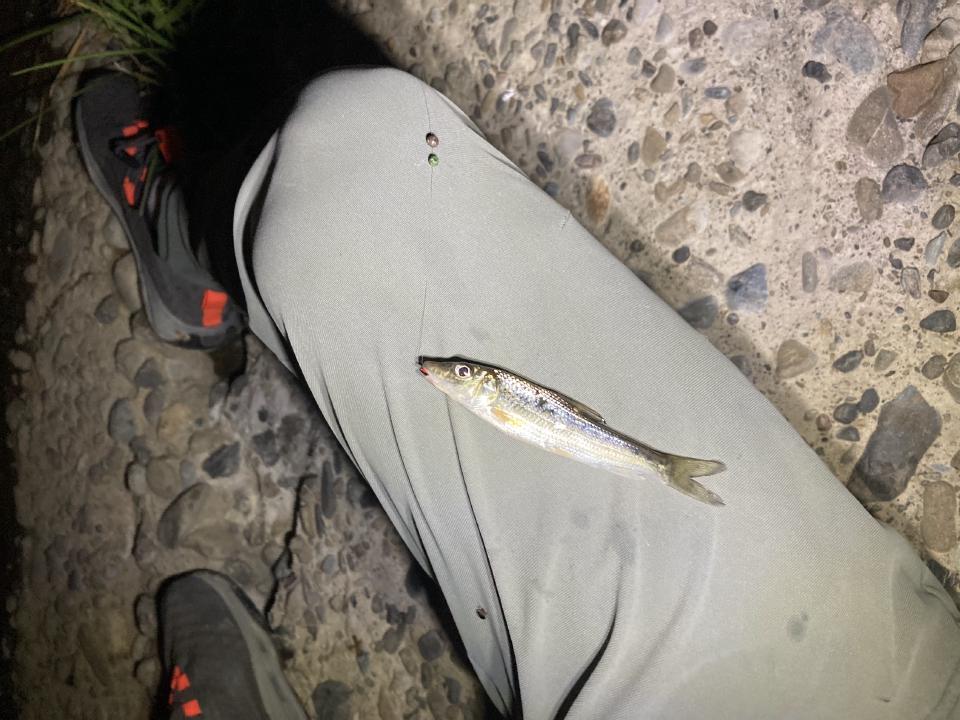
I suspect real-time fishing advice from AI chatbots is possible and can be useful. But when I fish, I enjoy either solitude or companion of a real human. Relying on an AI chatbot for real-time advice feels like cheating. It ruined the fun of the game. But I use AI for my post-trip analysis. The first use case I want AI’s help is fish identification, which I am bad at. Summer fishing in Tama River in Tokyo suburb yielded many similar-looking minnows possibly all belongs to Cyprinidae. In my experiences, ChatGPT was not great at picking out nuances. Its first shot was often missing. If you roughly knew what details are important to identify certain fish and pressed ChatGPT to look at these details, it would likely self-correct but might still make mistakes. For this, I do not find AI very useful in fish identification.
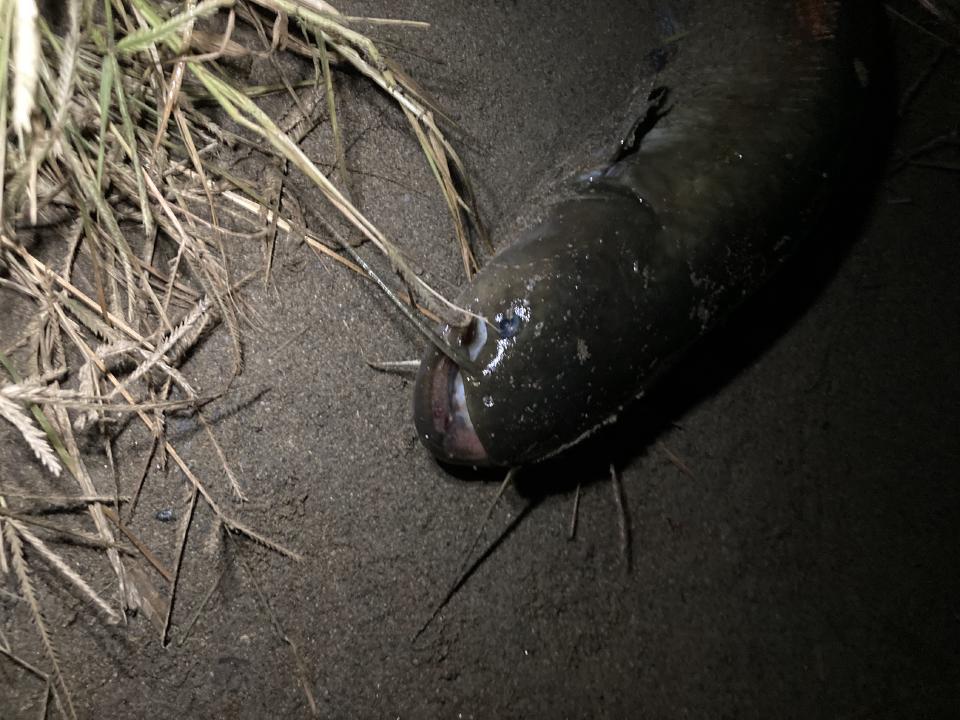
I also asked ChatGPT to recommend hooks for live or cut bait. I want to use the aforementioned minnows as bait for Amur catfish. The minnows were small and fragile for which the circle hooks I brought from US were not ideal. ChatGPT made some reasonable recommendations which I managed to find at a local tackle shop. With upgraded hooks, I successfully landed my first Amur catfish.
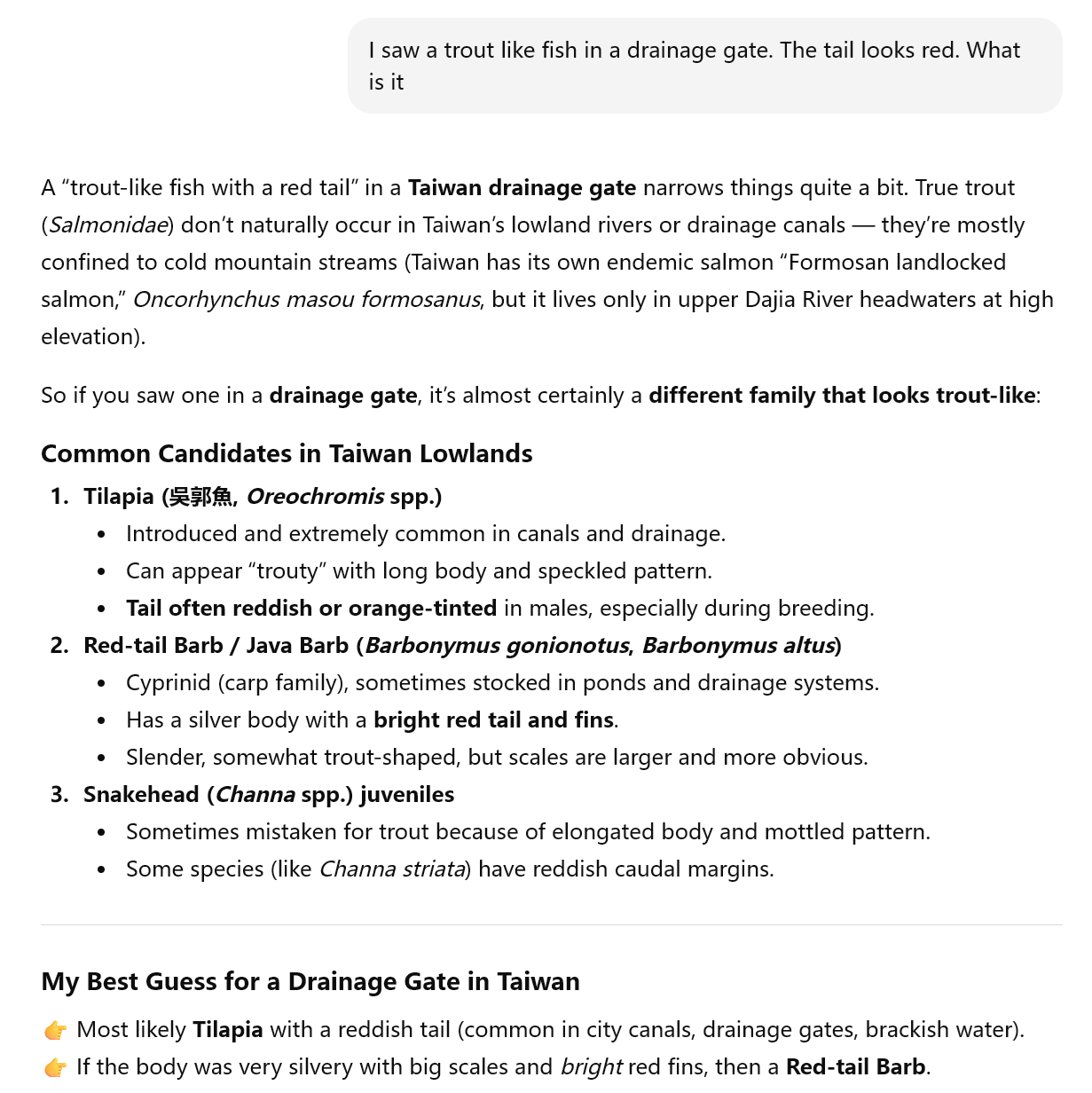
There are also times when I see fish in the water but do not have a closer or clear picture of it. I like to target any fish I see, so I need to identify them first. This is what happened when I fished in a Taipei suburb. While scouting fishing spots, I found many fish under a drainage gate in shallow water. Among them were a few large ones with red tails. I hooked a large fish on my first cast with a mini trout magnet. It was so strong and dashed into the cover and broke the line. I could not have them take the trout magnet again. I described the characteristics and the spot of the big fish I saw to ChatGPT. The first shot was tilapia. I feel the shape of the fish I saw was slenderer than a tilapia. When I followed up with this information, ChatGPT tried to self-correct but derailed. It came up with a fish species which seemly does not exist or at least could never exist in that particular water. I tried the same prompt on Gemini. It mentioned some other species which also seem unlikely to be true. Not many fish can survive in shallow water under a drainage gate littered with garbage after all.
At this point, I gave up AI chatbots and started browsing YouTube videos made by locals for inspiration. I stumped on a video using silk algae as bait for tilapia, which looks very interesting, and I feel like to give a try. I came back to that spot and managed to pull out a good size tilapia using silk algae I harvested at the spot. I became almost sure that the big fish I saw were all tilapias. ChatGPT was correct at the first shot!
The fishing adventure of that day does not end with the big tilapia. On the way back to hotel, I ran into a fisherman fishing without a hook. Instead, he was using a plastic water bottle, which immediately hooked me. He’s proabably from Vietnam and could not speak Chinese fluently. But he was very friendly and generous in sharing his unique fishing technique. What he did seems to be packing some sour flour in a plastic bottle which has holes to leak out flavor. Mullet following the favor will push itself into the bottle which then can be retrieved with the bottle. I am sure it’s a technique that is not well documented and hence AI chatbots would never be able to mention it. But they may soon be able to since I wrote about it.
LLM-backed AI is limited in its ability to extrapolate and likes to recite popular opinions. We should not expect AI to teach us to be creative or live unique life-experiences. Instead, it’s upon us to be creative and teach AI new tricks, especially in a game so open-ended and boundless called fishing.